
From Concept to Production: How AI Engineering Accelerates Enterprise Software Delivery

From Concept to Production: How AI Engineering Accelerates Enterprise Software Delivery
Enterprise software projects typically follow a predictable path: months of planning, weeks of implementation delays, integration bottlenecks, and launch dates that slip. But what if your timeline could compress by half without cutting corners on quality? AI engineering is rewriting that script for companies across Europe, turning the traditional six-month delivery cycle into a three-month sprint—and actually shipping more robust software.
The shift isn't about replacing developers. It's about fundamentally changing how engineers spend their time: less boilerplate typing, more architecture thinking; fewer debugging dead-ends, more strategic problem-solving. For SMBs and enterprises competing against larger players, this acceleration becomes a genuine competitive advantage.
The Real Cost of Traditional Software Delivery
Before we talk about acceleration, let's be honest about what slows projects down.
Your development team spends roughly 30-40% of their time on activities that don't directly advance your product: writing repetitive database access layers, scaffolding API endpoints, generating standard error handlers, migrating legacy code patterns, and reviewing syntactically correct but creatively redundant code. These tasks demand precision but don't require breakthrough thinking.
A mid-sized Romanian e-commerce platform we worked with recently spent eight weeks building CRUD operations and authentication scaffolding for their new data warehouse integration. The actual business logic—the part that differentiated their offering—was maybe 20% of the work. The remaining 80% was necessary plumbing.
That's where AI engineering changes the math.
How AI Engineering Transforms Engineering Productivity
Code generation isn't autocomplete—it's architectural acceleration.
Modern AI engineering tools don't just predict the next line of code. They understand context across your entire codebase, your tech stack, your naming conventions, and your architectural patterns. When a developer writes a function signature or describes a requirement, AI can generate not just the implementation but the supporting infrastructure: test cases, documentation, error handling, and integration points.
Here's what this looks like in practice:
A developer needs to build an invoice processing API. Instead of spending three days on boilerplate—controller classes, DTO mappings, validation rules, exception handlers—they describe the requirement to an AI assistant and review the generated code in 90 minutes. The AI has already applied your company's error handling standards, followed your URL naming conventions, and generated appropriate unit tests. The developer's job shifts from writing to validating and refining.
The time saved isn't trivial. We've measured engineering productivity gains of 40-60% on feature delivery timelines when AI engineering is properly integrated into development workflows. But the real advantage compounds: your team stays in flow state longer, architectural decisions get made faster, and code review cycles shorten because there's less syntactic noise to parse.
Scalable Development: Building Without the Headcount Tax
Enterprise growth usually means hiring more engineers. More engineers means longer onboarding, more communication overhead, more merge conflicts, and more code review burden. Your velocity plateaus around 15-20 people per team before organizational friction takes its toll.
AI engineering inverts that curve.
A team of eight experienced developers, augmented with AI-assisted code generation, can match the output of a team of twelve without the coordination overhead. They're not superhuman—they've just eliminated the repetitive work that scales linearly with headcount.
For a European software company with multiple client delivery streams, this means:
- Faster time-to-market without doubling your payroll
- Better code quality because your senior engineers focus on architecture instead of syntax review
- Reduced onboarding friction because junior engineers ship meaningful features faster with AI guidance
- More sustainable pace because boring work gets automated away
One of our partners, a SaaS platform serving the logistics sector across the EU, maintained their eight-person engineering team while doubling their feature output over eighteen months. They didn't hire; they integrated AI engineering into their development workflow and let their existing team operate at a higher level of abstraction.
From Concept to Production: The Accelerated Path
The traditional enterprise delivery timeline looks like this: Requirements (2 weeks) → Design (2 weeks) → Development (8 weeks) → Testing (3 weeks) → Deployment (1 week) = five months minimum.
AI engineering reshapes this:
Requirements clarification remains crucial—that doesn't change. But your requirements can be more detailed because AI tools help translate business requirements into technical specifications faster.
Architecture and design actually become more important because your team has more time to spend on it. Instead of sketching on a whiteboard and immediately jumping into coding, you can prototype multiple approaches, validate patterns, and document decisions thoroughly. AI assists here too—generating architecture diagrams, API specifications, and database schemas from descriptions.
Development accelerates dramatically. With AI code generation handling 50-60% of implementation (the parts that are genuinely algorithmic but not novel), your developers focus on the 15-20% that's truly custom logic and the crucial 20-25% that's integration and testing. Feature delivery that took three weeks now takes ten days.
Testing becomes smarter, not just faster. AI can generate test cases automatically, identify edge cases your manual testing might miss, and even help with performance testing and security scanning. Your QA process is more comprehensive because you're covering more scenarios in less time.
Deployment happens sooner because you're not shipping at the last minute. You've had breathing room to validate each component.
The result: A project that traditionally took five months now delivers in twelve to fourteen weeks. That's not overtime—that's genuine acceleration through smarter tool use.
Practical Considerations: Making AI Engineering Work
Speed without governance creates technical debt. If your team is just using AI to write code faster without architectural oversight, you'll pay for it in maintenance costs and scaling problems.
The companies getting the most value from AI engineering do three things:
-
Establish clear standards for what AI can and cannot generate. Most teams draw the line at business logic and cross-cutting concerns that need human review.
-
Invest in code review discipline. AI-generated code is often correct, but "often" isn't good enough. Your best engineers need to spend time validating AI output, not typing boilerplate.
-
Measure what matters. Track delivery timelines, defect rates, and maintenance costs—not just lines of code or velocity metrics. You want to verify that speed doesn't sacrifice quality.
The Competitive Reality
In Europe's software market, delivery speed has become a competitive differentiator. Enterprises expect feature delivery in weeks, not months. Startups are shipping products that once took years to build. The companies winning aren't necessarily the ones with the biggest budgets—they're the ones that figured out how to compress timelines without sacrificing engineering standards.
AI engineering is the practical tool that makes that compression possible.
If your team is still writing database access layers by hand in 2026, you're not just slow—you're burning engineering capacity on commoditized work. Your best developers should be solving problems unique to your business, not implementing standard patterns.
That's where we come in. At ICE Felix, we help Romanian and European enterprises integrate AI engineering into their delivery workflows—not as a replacement for skilled developers, but as a force multiplier. We've worked with teams that needed to cut their feature delivery timeline in half while maintaining code quality, and we've delivered those results consistently.
If you're curious about how AI engineering could reshape your software delivery, let's talk about your specific situation—no generic pitch, just an honest conversation about what's possible.
Your next release could be months ahead of schedule.
Ready to build something great?
Tell us about your project and we will engineer the right solution for your business.
Start a ConversationMore from the Lab
Building Scalable Systems with AI-Powered Development: A Framework for Modern Engineering Teams
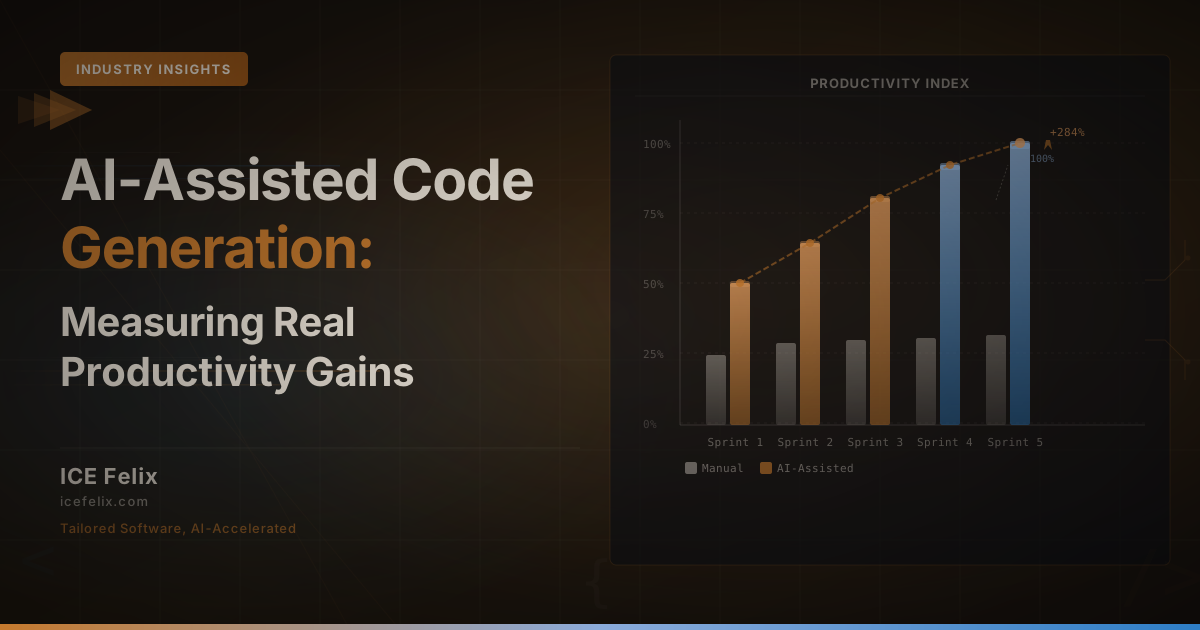
AI-Assisted Code Generation: Measuring Real Productivity Gains in Engineering Teams
