
Building Scalable Systems with AI-Powered Development: A Framework for Modern Engineering Teams
Your product gained traction. Users are signing up faster than your infrastructure can handle. The question isn't whether your system will break—it's when. Building for scale from day one isn't about predicting the future; it's about making intelligent architectural choices today that won't cripple your team tomorrow.
Modern AI engineering changes how teams approach this problem. It's not magic, but it is a significant productivity multiplier when used deliberately.
The Reality of Scaling Without Strategy
Most engineering teams build their first version to work—not to scale. That's fine. But the moment you need to handle 10x traffic, manage growing data complexity, or onboard new developers, architectural debt compounds quickly.
We've worked with Romanian SaaS companies that invested months retrofitting systems because early decisions locked them into inefficient patterns. A monolithic API that worked for 100 concurrent users becomes a bottleneck at 10,000. Database queries that ran in milliseconds timeout under load. And onboarding new engineers means they're debugging production issues instead of shipping features.
The cost of scaling after problems appear is 3-5x higher than designing for it incrementally.
Where AI Engineering Accelerates System Design
AI-assisted coding isn't about replacing architects or engineers. It's about compressing the time between knowing what scalable looks like and actually building it.
Here's where AI engineering delivers measurable wins:
Rapid iteration on architectural patterns. When your team debates microservices vs. monoliths, or when vs. when-not to introduce message queues, AI coding assistants help you prototype both approaches quickly. You're not arguing theory—you're running code. Claude or ChatGPT can generate service boundaries, async job handlers, caching layers, and load balancing strategies based on your specific constraints. In two hours, you've validated an architecture that would have taken a week of design meetings.
Database schema optimization at scale. Designing normalized schemas that actually perform at production scale is hard. AI assistants can generate multiple schema designs, suggest indexing strategies, and identify N+1 query patterns before they ship. For an EU fintech startup processing thousands of daily transactions, this saved months of performance debugging.
Boilerplate that doesn't slow you down. Repetitive code—database migrations, API endpoints, validation layers, monitoring instrumentation—is where fast delivery stalls. AI-assisted coding generates solid scaffolding, freeing engineers to focus on business logic and architectural decisions that actually matter.
A Framework: Building Scalable Systems with AI
Phase 1: Architectural Contracts (Week 1)
Before writing production code, define your system's scalability constraints:
- Expected peak load (requests/sec, data volume)
- Acceptable latency
- Uptime requirements
- Team size and deployment capacity
Use AI engineering to generate option briefs for each constraint. Need to handle 5,000 requests/sec? Ask your AI assistant to outline a distributed caching strategy, database sharding approach, and load balancing design. You'll evaluate them in hours instead of weeks.
Phase 2: Core Infrastructure (Weeks 2-3)
With architecture agreed, AI-assisted coding accelerates infrastructure setup:
- API gateway and rate limiting logic
- Horizontal scaling patterns for your primary services
- Database query optimization and connection pooling
- Logging and monitoring instrumentation
Your team writes the business rules and edge cases. AI handles generating the scaling infrastructure, testing utilities, and deployment configurations. Engineering productivity jumps because engineers spend time on problems AI can't solve alone.
Phase 3: Iterative Load Testing and Tuning (Ongoing)
Deploy early. Real traffic exposes assumptions better than any forecast. AI tools help teams:
- Generate realistic load test scenarios
- Identify bottlenecks in profiling data
- Propose optimizations to slow queries or services
- Automate performance regression testing
A Bucharest-based B2B SaaS company used this approach to scale from 500 to 50,000 daily API calls in three months. Their team went from firefighting production issues to proactively tuning performance because AI-assisted coding freed them from repeating boilerplate changes.
AI Engineering Doesn't Replace Architecture—It Amplifies It
This matters: good architects are still essential. AI accelerates their work, it doesn't replace judgment.
The architect who understands eventual consistency, circuit breakers, and graceful degradation still needs to make those decisions. But instead of spending two weeks writing distributed cache boilerplate, they spend two days. Instead of hand-coding ten monitoring dashboards, they design the monitoring strategy and generate the dashboards in hours.
For engineering productivity, this is transformational. Your team ships scalable systems faster. Your architects focus on hard problems. Developers spend time on features users care about, not endless configuration.
Common Pitfalls to Avoid
Over-engineering for scale you don't have. AI makes it easy to generate complex infrastructure. Resist the urge. Start simple. Scale incrementally. Use AI to accelerate your scaling path, not to build unnecessary abstraction layers.
Treating AI output as production-ready. It's a powerful starting point, not finished code. Your team still reviews, tests, and refines. AI engineering amplifies good judgment; it doesn't eliminate the need for it.
Ignoring operational complexity. Distributed systems are harder to operate. AI can generate the code, but your team owns debugging, monitoring, and incident response. Build operational maturity alongside architectural sophistication.
The Path Forward
Scalable systems aren't built by guessing or reactive firefighting. They're built by teams that combine solid architecture with fast iteration. AI engineering enables both.
For Romanian and EU SMBs, this is a competitive advantage. Larger enterprises move slower, weighed down by legacy systems and rigid processes. Your team can design and deploy scalable systems in quarters, not years. Fast delivery isn't reckless—it's informed speed, where architectural decisions are validated quickly and adjusted based on real data.
The teams winning in this environment aren't choosing between "move fast" or "build for scale." They're doing both. AI-assisted coding is how.
If your team is ready to accelerate engineering productivity while building systems that scale, we'd like to talk. At ICE Felix, we've helped Romanian and European engineering teams deliver scalable software faster. We know the challenges—scaling infrastructure, onboarding engineers quickly, maintaining quality under fast delivery pressure.
We combine AI engineering expertise with practical software architecture. Let's build something that grows with your business.
Get in touch or explore how AI-accelerated development works for your team.
Ready to build something great?
Tell us about your project and we will engineer the right solution for your business.
Start a ConversationMore from the Lab
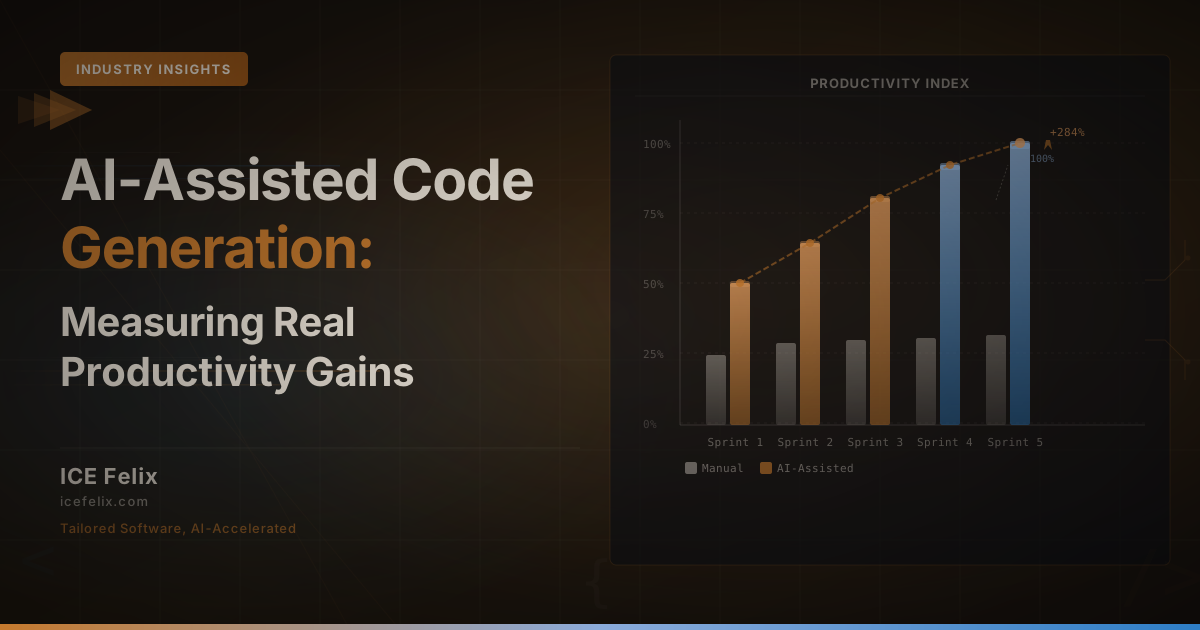
AI-Assisted Code Generation: Measuring Real Productivity Gains in Engineering Teams

From Concept to Production: How AI Engineering Accelerates Enterprise Software Delivery
