
AI-Assisted Code Generation: Measuring Real Productivity Gains in Engineering Teams
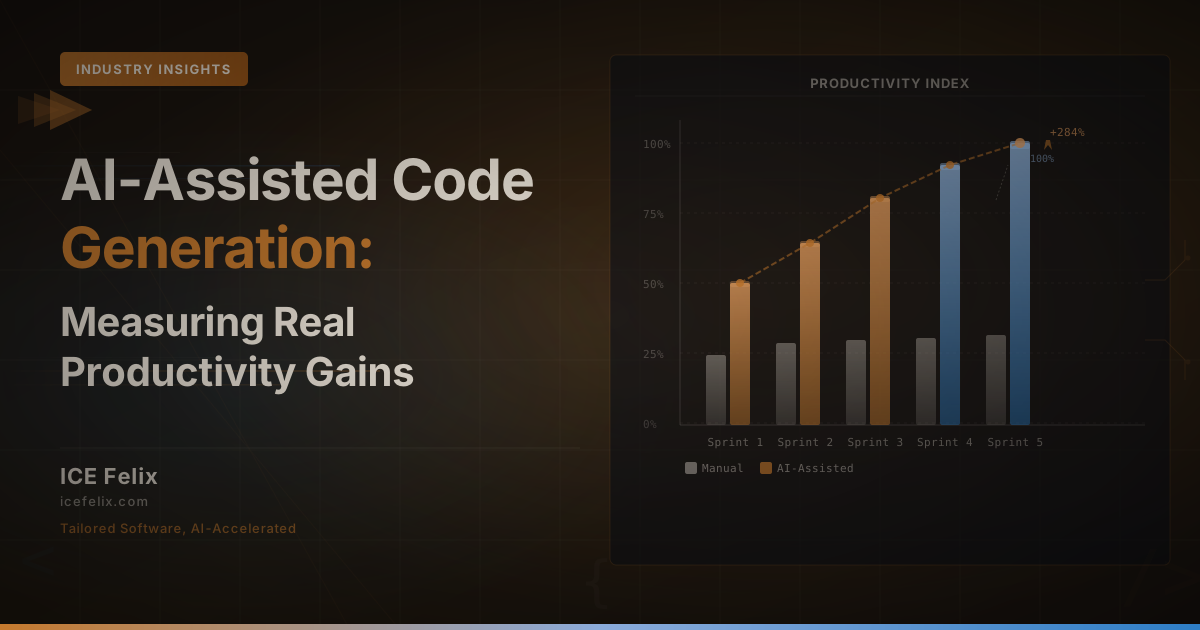
Your developers are busy. Between meetings, code reviews, and firefighting production issues, there's barely time to focus on what matters: shipping features that move your business forward. AI-assisted code generation sounds like the answer—but is it really making your team more productive, or just creating technical debt you'll regret later?
The honest answer depends on how you measure it and what you're actually asking your AI to do.
The Productivity Paradox: Speed Isn't Everything
When people talk about AI code generation improving productivity, they often point to metrics like "lines of code per day" or "features shipped per sprint." These numbers can look impressive in a deck, but they're missing the real story.
A developer who generates 500 lines of boilerplate code in an afternoon hasn't necessarily become more productive—they've just moved repetitive work faster. If that code still needs review, refactoring, testing, and debugging, you haven't actually shortened your delivery timeline.
The real productivity gains from AI engineering emerge when you measure what actually matters to your business:
- Time to production: How long from "we need this feature" to "it's live and tested"
- Quality metrics: Bug escape rate, post-deployment incidents, technical debt accumulation
- Developer satisfaction: Are engineers spending less time on tedious work and more time solving complex problems?
- Review friction: How much back-and-forth happens before code merges?
At ICE Felix, we've worked with EU SMBs that initially focused on code velocity alone. What they discovered is that AI-powered development without guardrails creates more problems downstream. The real win comes when you measure the full pipeline.
Where AI Code Generation Delivers Measurable Returns
AI code generation works exceptionally well in specific, defined contexts. Knowing where to deploy it is half the battle.
Pattern-Heavy Code: CRUD operations, API wrappers, repetitive database queries, and boilerplate configuration files are where AI shines. A developer can outline the structure and let AI generate the scaffold, then focus on business logic. We've seen teams reduce backend scaffolding time by 40-60% here—not because AI is magic, but because it's genuinely good at mechanical pattern-matching.
Test Coverage: Writing comprehensive tests is often deferred because it feels tedious. AI can generate unit test shells and edge case scenarios based on your code. Teams using this strategically report faster test coverage growth, which translates directly to fewer bugs reaching production.
Documentation and Type Definitions: TypeScript interfaces, API documentation, and function signatures—these are information-dense and repetitive. AI can draft them from your code, freeing developers to focus on accuracy rather than documentation busywork.
Exploration and Prototyping: When building a feature you've never built before, AI can help you explore multiple implementation approaches quickly. You iterate on the concept faster, which reduces design rework later.
The common thread: these are tasks where the output is verifiable and structured, not ambiguous or creative.
The Hidden Costs: What You Need to Monitor
AI code generation introduces costs that don't show up in velocity metrics.
Review burden grows first: When your team suddenly generates 3x more code per day, code reviews don't become faster—they become bottlenecks. The person reviewing needs to understand not just what the code does, but whether the AI made reasonable trade-offs. We've seen teams struggle here because they didn't adjust their review process for AI-assisted code.
Technical debt accumulates quietly: Generated code often works, but it's not always optimal for your specific system. It doesn't know about your architectural decisions, performance constraints, or long-term maintenance patterns. Without strict review standards, you end up with code that functions today but becomes a liability in six months.
False confidence in junior developers: A junior developer can generate code that looks correct but has subtle concurrency issues, memory leaks, or security vulnerabilities. AI can amplify inexperience if you're not careful. The solution isn't to avoid AI—it's to pair it with stronger code review practices, especially for junior team members.
Hallucinations and assumptions: AI code generation sometimes produces code that looks plausible but references non-existent libraries or makes incorrect assumptions about your codebase. Your team needs to verify more carefully when AI is in the loop.
The cost? Additional review time, more QA cycles, and sometimes rework. If you're not accounting for these, your productivity gains are an illusion.
Structuring AI-Powered Development for Real Efficiency
Here's how to actually measure and achieve productivity improvements:
Define your baseline first: Before deploying AI code generation widely, measure your current state. How long does it take to ship a feature end-to-end? What's your bug escape rate? How much time do developers spend on routine tasks? Without baselines, you can't measure improvement.
Start narrow: Pick one team and one type of task—say, API endpoint generation. Run a 4-week pilot. Measure specifically: time to write, time to review, bugs found, post-deployment issues. Use this data to decide if it's worth expanding.
Invest in review discipline: If you adopt AI code generation, your review process needs to get stricter, not looser. Automated checks help—linters, type checkers, security scanners—but human review of AI-generated code should be thorough.
Pair junior developers with experienced reviewers: AI code generation is a powerful amplifier. In the hands of an experienced engineer who understands your system, it's a force multiplier. With a junior developer who doesn't yet have judgment, it can become a liability. Structure your pairing accordingly.
Measure end-to-end, not just code generation: Track time from feature request to production. Include review time, testing, deployment, and post-deployment issues. This is the number that actually matters to your business.
The Realistic ROI
Most SMBs we work with see meaningful productivity gains 3-6 months after thoughtfully deploying AI code generation. The numbers look like:
- 25-35% reduction in boilerplate-heavy sprint work
- 15-20% improvement in time-to-market for feature releases (once review processes stabilize)
- 10-15% improvement in test coverage growth
- Measurable improvement in developer morale (less time on tedious work)
These aren't revolutionary numbers, but they're real. And they compound—a 20% improvement in delivery speed means you ship more features, gather more customer feedback, and stay more competitive.
The Path Forward
AI-assisted code generation isn't a productivity silver bullet, but it's also not hype. The teams that see real gains are the ones that measure carefully, invest in process discipline, and use AI where it actually excels: routine, verifiable, pattern-heavy work.
If you're building an engineering team or scaling your software delivery, these decisions matter. You need to know whether your tools are actually accelerating your business or just creating the illusion of motion.
At ICE Felix, we specialize in tailored software delivery for SMBs—which means we care deeply about real engineering efficiency, not vanity metrics. If you're evaluating how AI engineering fits into your development strategy, or you're struggling to get measurable ROI from code generation tools, we can help you set up the right framework and hold yourself accountable to actual results.
Let's talk about where you are now and where you want to be.
Ready to build something great?
Tell us about your project and we will engineer the right solution for your business.
Start a ConversationMore from the Lab
Building Scalable Systems with AI-Powered Development: A Framework for Modern Engineering Teams

From Concept to Production: How AI Engineering Accelerates Enterprise Software Delivery
